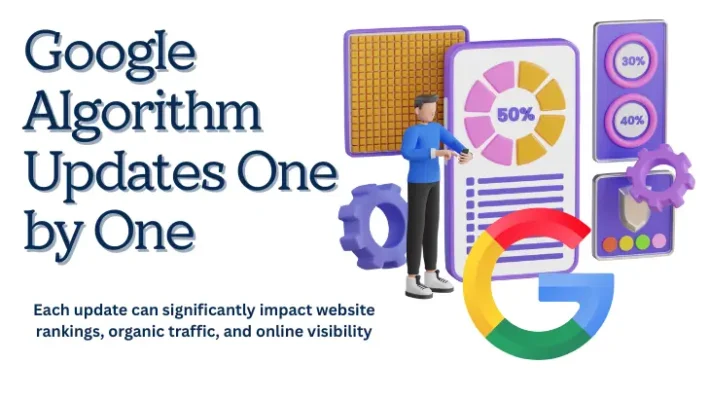
Staying ahead of Google algorithm updates is crucial for anyone in digital marketing, SEO, or content creation. Each update can significantly impact website rankings, organic traffic, and online visibility. In this blog, we’ll walk you through Google’s major algorithm updates one by one from 2003 to 2026, with real-world explanations, trending keywords, and SEO insights to help you stay competitive.
What Are Google Algorithm Updates?
Google uses a complex set of algorithms to deliver the most relevant and high-quality search results. These algorithms are regularly updated to improve search accuracy, fight spam, and promote valuable content. These updates can be minor daily tweaks or major core updates that affect millions of sites.
A Timeline of Google Algorithm Updates (One by One)
Let’s dive into the most impactful Google updates over the past two decades chronologically:
Florida Update (2003)
This was Google’s first major update targeting black-hat SEO tactics like keyword stuffing and invisible text. It disrupted many affiliate marketers during the holiday season.
Impact: Legitimate sites improved in rankings while manipulative tactics were penalized.
Panda Update (2011)
Panda aimed to lower rankings of low-quality content sites with thin content, excessive ads, or duplicate pages. Content farms were hit hard.
Real-world example: Article directories and auto-generated content pages saw a drastic drop in organic traffic.
📝 Focus: Content quality and originality.
Penguin Update (2012)
Penguin targeted manipulative link-building strategies, such as paid links and link schemes. Google shifted focus to natural backlinks.
Real-world tip: Stop buying bulk backlinks. Build authority through guest posting, PR, and genuine outreach.
📝 Focus: Link quality, anchor text diversity.
Hummingbird Update (2013)
This update was a big leap toward semantic search. Instead of just keywords, Google began interpreting user intent and context.
Real-world impact: Long-tail keywords and conversational search terms gained importance.
📝 Focus: Natural language processing.
Pigeon Update (2014)
Pigeon refined local search results, improving proximity-based listings and local directory signals.
Example: Local businesses optimized for Google My Business saw traffic spikes.
📝 Focus: Location, distance, local relevance.
Mobile-Friendly Update (2015)
Dubbed “Mobilegeddon” this update made mobile responsiveness a ranking factor.
Real-world shift: Non-mobile-optimized sites dropped in mobile search results.
📝 Focus: Mobile UX, responsive design.
RankBrain Update (2015)
Google introduced machine learning into its algorithm for better query interpretation and ranking.
Key takeaway: Pages that satisfied user intent with relevant, engaging content ranked higher.
📝 Focus: AI-powered ranking, dwell time, CTR.
Possum Update (2016)
This local search update filtered out duplicate business listings and fine-tuned proximity filters.
Example: Two businesses in the same building could now appear separately in search.
📝 Focus: Local pack diversity, filtering spam.
Fred Update (2017)
This unnamed but confirmed update targeted low-value content sites, especially those with excessive ads and little useful info.
Example: Ad-heavy blogs with clickbait titles lost their rankings.
📝 Focus: Ad-heavy layouts, affiliate spam.
BERT Update (2019)
BERT (Bidirectional Encoder Representations from Transformers) helped Google understand the context of words in a sentence.
Real-world application: Better ranking for long-tail and natural questions (e.g., “how to fix a broken printer nozzle”).
📝 Focus: NLP, conversational search.
Core Web Vitals Update (2021)
This update made page experience an official ranking signal, including loading speed, interactivity, and visual stability.
Real-world fix: Compress images, remove unused code, and reduce pop-ups.
📝 Focus: UX signals, technical SEO.
Helpful Content Update (2022)
Google emphasized people-first content written to help users, not to manipulate search engines.
Real example: Generic listicles and AI-spun content dropped. Authoritative and well-researched content rose.
📝 Focus: User-centric content, authenticity.
March 2024 Core Update & Spam Updates
Google introduced more aggressive spam detection, especially targeting AI-generated fluff, doorway pages, and manipulative redirects.
Update Insight: Emphasized EEAT Experience, Expertise, Authoritativeness, and Trustworthiness.
📝 Focus: Quality signals, originality, trust markers.
Key Lessons from Google Updates
These updates reveal a pattern Google always rewards websites that:
-
Provide original, helpful content
-
Offer a great user experience
-
Keep up with technical best practices
How to Stay Prepared for Future Google Updates
-
Focus on User Intent: Answer user questions thoroughly and clearly.
-
Update Content Regularly: Outdated content can drop in rankings.
-
Avoid Shortcuts: Keyword stuffing, spammy links, and AI-spun content are risky.
-
Track Performance: Use tools like Google Search Console, Ahrefs, SEMrush, or Moz.
-
Improve Page Experience: Optimize loading speed, mobile usability, and site security (HTTPS).
Tools to Monitor Google Algorithm Changes
-
Google Search Central Blog
-
SEMrush Sensor
-
MozCast
-
Twitter accounts of SEO influencers
Final Thoughts: Keep Learning, Keep Optimizing
Google’s algorithm will never stop evolving. But instead of fearing updates, embrace them as opportunities to improve. Each update pushes the web toward higher-quality, more useful, and more ethical content. Whether you’re a small business owner, an SEO professional, or a content creator understanding and adapting to these changes is key to your digital success.
Need Help Navigating SEO After an Update?
As an IT and digital marketing expert, we help businesses like yours stay ahead in search. Reach out for a free SEO audit and discover how your website can align with Google’s latest updates.