Introduction
Pay-Per-Click (PPC) advertising has always been a data-driven marketing channel. For years, advertisers relied on manual keyword research, bid adjustments, and creative testing to generate results. But by 2026, the PPC landscape has shifted dramatically. Artificial Intelligence (AI) has moved from being a helpful tool to becoming the central engine powering campaign strategy, optimization, and performance.
Today, AI influences nearly every stage of PPC from audience targeting and keyword discovery to bid management, creative generation, and performance prediction. Platforms like Google Ads and Meta Ads are embedding automation into their core systems, and many campaigns now rely heavily on machine learning rather than manual control. In fact, AI-driven automation already powers the majority of paid campaigns, and tools like Performance Max have shown significantly higher conversion performance compared to manual setups.
This article explores how AI is transforming PPC advertising in 2026, what marketers need to understand, and how businesses can leverage these changes to remain competitive.
The Evolution of PPC: From Manual Control to AI Automation
Traditional PPC campaigns required constant manual effort. Marketers adjusted bids, selected keywords, monitored performance metrics, and manually tested ad variations. This process was time-consuming and limited by human analytical capacity.
AI has changed this dynamic completely. Machine learning algorithms can now analyze thousands of signals simultaneously including device type, user location, browsing behavior, time of day, and historical performance to make real-time optimization decisions that humans simply cannot match.
As a result, the focus of PPC management has shifted from tactical execution to strategic oversight. Instead of spending hours adjusting bids or keywords, marketers are now responsible for guiding AI systems with accurate data, business goals, and creative direction.
This transition represents a fundamental shift: PPC managers are evolving into data strategists rather than manual operators.
AI-Powered Automation in Campaign Management
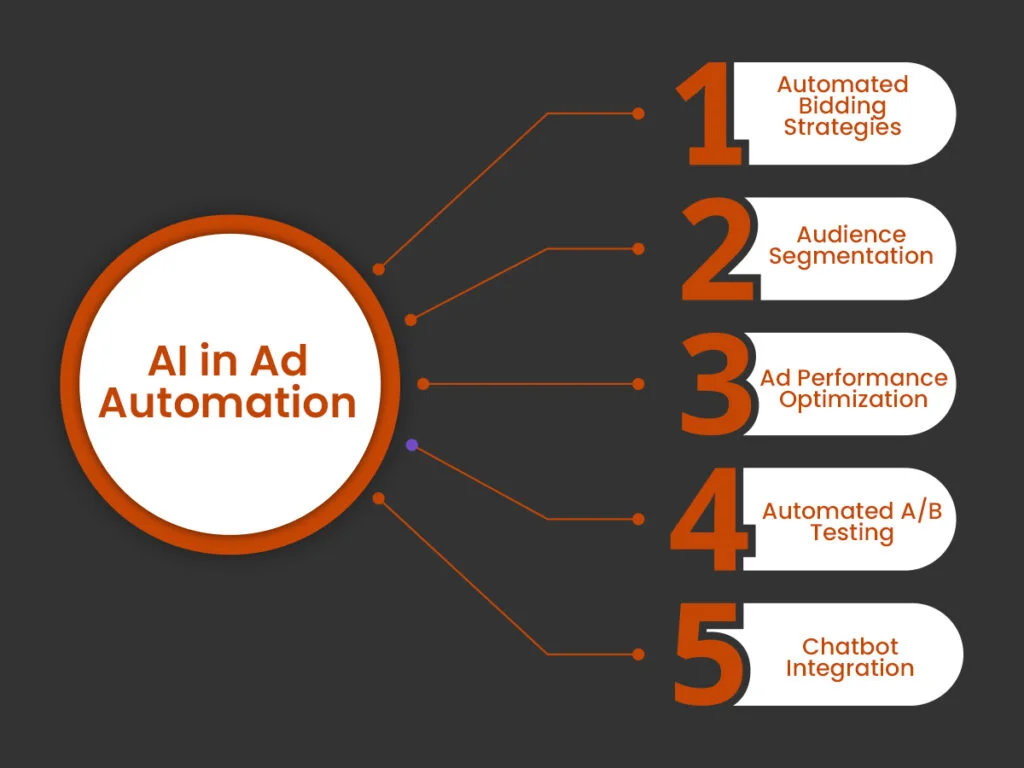
Automation is one of the most visible changes brought by AI to PPC advertising. Campaign types such as Performance Max combine inventory across multiple channels search, display, video, and more and automatically allocate budgets to maximize conversions.
AI automation provides several advantages:
- Real-time bid adjustments based on market conditions
- Automatic placement optimization across platforms
- Discovery of new audience segments and keywords
- Reduced manual workload for advertisers
Campaigns that adopt automation frequently achieve higher conversions while requiring less manual intervention.
Major platforms are also pushing automation further. Meta, for example, aims to allow advertisers to input a product image and budget while AI handles creative production, targeting, and optimization automatically by 2026.
This demonstrates how PPC is transitioning toward full lifecycle automation where AI manages most campaign execution.
The Rise of Keywordless Targeting
Keywords were historically the foundation of PPC. However, AI is reducing dependence on explicit keyword targeting. Advanced campaign structures now analyze landing pages, creative assets, and contextual signals to match ads with relevant search intent even when those queries were never manually targeted.
Early adopters of these AI-driven approaches have reported strong improvements in performance metrics such as conversion rates and click-through rates.
This shift means advertisers must rethink strategy:
- Intent signals matter more than keyword lists
- Content relevance influences targeting success
- Data quality determines AI accuracy
In essence, PPC optimization is moving from keyword management toward signal management.
Smart Bidding and Predictive Analytics
AI-driven bidding strategies are now standard practice in PPC campaigns. Smart bidding uses machine learning models to predict the likelihood of conversion and adjust bids accordingly. These models analyze complex behavioral patterns and contextual signals to maximize results.
Predictive analytics further enhances this process by forecasting demand trends and campaign performance before execution. This allows advertisers to anticipate market changes and allocate budgets more efficiently.
The benefits include:
- Better budget allocation
- Reduced wasted spend
- Improved return on ad spend (ROAS)
- More strategic planning capabilities
AI’s predictive abilities transform PPC from reactive marketing to proactive marketing.
Generative AI and Creative Development
Creative testing used to require extensive human effort. Now, generative AI tools produce headlines, visuals, and videos tailored to specific audience segments.
Research shows AI-generated advertising content can match or even outperform human-created ads in persuasive effectiveness, demonstrating strong audience preference rates in experimental studies.
Additionally:
- AI personalizes ad messaging at scale
- Creative variants are generated instantly
- A/B testing cycles become faster
This capability enables hyper-personalized advertising, where content adapts to user behavior in real time.
Hyper-Personalization and Audience Targeting
Modern AI systems excel at identifying behavioral patterns and segmenting audiences. By integrating multimodal data and persona-based modeling, AI frameworks can deliver culturally relevant and personalized advertising messages.
Hyper-personalization leads to:
- Higher engagement
- Improved conversion rates
- Enhanced user experiences
The result is advertising that feels less intrusive and more relevant to the individual consumer.
AI Integration into Search Experiences
Search engines themselves are evolving through AI-powered answer interfaces. AI-generated summaries and conversational responses increasingly dominate search results, reducing traditional click behavior.
Ads are now appearing within AI-generated answers rather than only above or below search results. Placement depends more on intent relevance than keyword match precision.
This trend is reshaping PPC strategy because:
- Visibility patterns are changing
- Click opportunities are shifting
- Campaign structure must adapt to new placements
Advertisers must optimize for intent-driven relevance to remain visible.
Voice, Visual, and Conversational Advertising
AI is enabling new forms of interaction, including voice and visual search advertising. Users can search using spoken queries or images, and AI interprets these signals to serve relevant ads.
Conversational ad formats are also emerging, allowing users to interact directly with ads through chat-like interfaces.
These innovations expand PPC beyond text-based search and open new engagement channels.
Data, Privacy, and the Role of First-Party Insights
As third-party cookies decline, AI is increasingly relying on first-party data sources such as customer interactions and email lists to refine targeting models.
This shift highlights the importance of:
- Data collection strategies
- CRM integration
- Privacy-compliant targeting
Organizations that manage first-party data effectively will gain competitive advantages.
The Challenges and Risks of AI in PPC
Despite its benefits, AI introduces challenges:
- Limited transparency in automated decisions
- Risk of misalignment without proper oversight
- Potential cost inefficiencies if left unmanaged
Automation systems sometimes underperform compared to traditional methods if not guided strategically.
Therefore, human oversight remains essential. AI should be treated as a partner rather than a replacement for strategic thinking.
The Future Outlook
The trajectory of PPC clearly points toward deeper AI integration. Industry investment trends show major technology companies continuing to expand AI capabilities in advertising infrastructure.
As platforms compete to automate ad creation, targeting, and optimization, marketers will increasingly focus on:
- Data strategy
- Creative positioning
- Brand messaging
- Conversion architecture
PPC will remain performance-driven, but execution will become largely machine-led.
Conclusion
AI is redefining PPC advertising in 2026 by automating operations, enhancing personalization, and reshaping user interactions with ads. From predictive bidding to keywordless targeting and generative creative production, AI is making campaigns smarter, faster, and more efficient.
However, success in this new era requires balance. Advertisers must embrace automation while maintaining strategic oversight. Those who adapt to AI-driven workflows focusing on data quality, creativity, and audience insight — will thrive in the evolving digital advertising ecosystem.
Ultimately, AI is not replacing marketers it is elevating their role. The future of PPC advertising belongs to those who learn to collaborate with intelligent systems rather than compete against them.
FAQs
What role does AI play in PPC advertising today?
AI automates bidding, targeting, creative generation, and optimization by analyzing large datasets in real time. It helps improve performance and reduce manual effort.
Is AI replacing PPC professionals?
No. AI handles execution tasks, but strategic planning, data guidance, and creative direction still require human expertise.
What are AI-driven campaigns like Performance Max?
They are automated campaign types that distribute ads across multiple channels and optimize budget allocation to maximize conversions.
Does AI eliminate the need for keywords?
Not entirely, but keyword importance is decreasing as AI systems focus more on user intent and contextual signals.
How does AI improve ad creatives?
Generative AI tools produce personalized headlines, images, and videos, enabling faster testing and improved audience engagement.
Can AI predict campaign performance?
Yes. Predictive analytics uses historical data patterns to forecast results and optimize budget planning.
What risks come with AI automation?
Risks include lack of transparency, possible inefficiencies, and reduced control if campaigns are not monitored properly.
How should businesses prepare for AI-driven PPC?
They should invest in data quality, adopt automation gradually, maintain oversight, and focus on strategic decision-making.