India’s Growing AI Talent Gap Signals a New Workforce Challenge
Artificial Intelligence has moved from experimentation to execution. Businesses across India are rapidly integrating AI into marketing, customer service, software development, healthcare, finance, education, and manufacturing. While adoption is accelerating, a significant challenge has emerged: a shortage of skilled AI professionals.
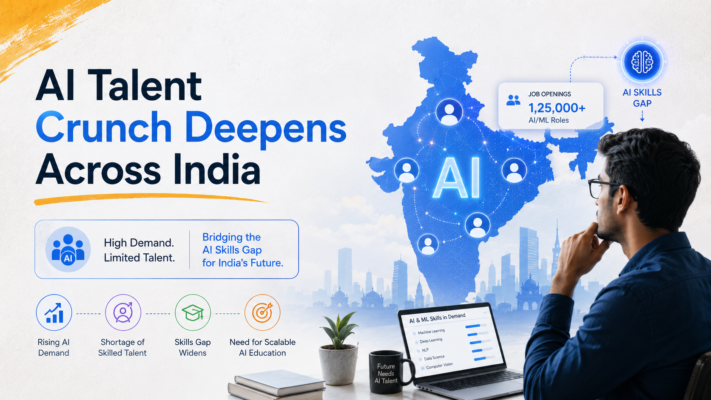
The AI Talent crunch is becoming one of the biggest barriers to India’s digital transformation ambitions. Organizations are investing heavily in AI search, AI marketing, automation, machine learning, and generative AI solutions, yet many struggle to find qualified professionals capable of building, deploying, and managing these technologies.
As demand continues to outpace supply, companies are rethinking hiring strategies, employee training programs, and workforce development initiatives.
Why AI Talent Demand Is Rising Across India
India has become one of the world’s fastest-growing AI markets. Startups, enterprises, government agencies, and technology companies are competing for a limited pool of AI specialists.
Several factors are driving this demand:
- Rapid adoption of Generative AI tools
- Growth in AI-powered search technologies
- Increased investment in AI business solutions
- Expansion of AI marketing platforms
- Automation of customer support and operations
- Growing need for data-driven decision-making
Organizations no longer view AI as a future technology. It is now considered a business necessity.
According to multiple industry reports, AI-related job postings in India have grown significantly over the last few years, particularly in cities such as Bengaluru, Hyderabad, Pune, Gurugram, Chennai, and Mumbai.
The Current State of AI Talent in India
While India produces millions of graduates annually, only a small percentage possess practical AI skills that employers require.
Many candidates understand theoretical concepts but lack experience in:
- Large Language Models (LLMs)
- Prompt engineering
- Machine learning deployment
- AI product development
- Data engineering
- Model optimization
- AI governance and ethics
This mismatch between academic learning and industry requirements is widening the talent gap.
Skills Most in Demand
Organizations are actively searching for professionals with expertise in:
| AI Skill Area | Demand Level | Industry Applications |
| Generative AI | Very High | Content creation, chatbots, automation |
| Machine Learning | Very High | Predictions, analytics |
| Data Science | High | Business intelligence |
| Prompt Engineering | High | AI productivity tools |
| AI Search Optimization | High | Search visibility and discovery |
| Natural Language Processing | High | Customer support, assistants |
| AI Marketing | High | Personalization and campaign automation |
| Computer Vision | Medium | Manufacturing, healthcare |
| AI Security | Growing | Risk management |
The shortage is especially severe for experienced professionals who can lead AI transformation projects.
AI Search Is Creating New Job Categories
The evolution of AI search is changing how businesses approach online visibility.
Traditional SEO focused on search engine rankings. Today, businesses are adapting to AI-powered search experiences that provide direct answers rather than lists of links.
This shift is creating demand for specialists in:
AI Search Optimization
Professionals now help brands become visible inside AI-generated responses.
Responsibilities include:
- Structured content development
- Entity optimization
- Knowledge graph enhancement
- Semantic search strategies
- Content authority building
Companies that previously hired only SEO specialists are now recruiting AI search experts who understand how generative search systems evaluate content quality and trustworthiness.
AI Marketing Is Driving Recruitment Demand
Marketing departments are becoming major employers of AI Talent.
AI marketing platforms are helping brands automate:
- Content creation
- Audience segmentation
- Ad targeting
- Customer journey mapping
- Email personalization
- Performance analysis
As AI tools become more sophisticated, marketers need new technical skills.
The Rise of Hybrid Professionals
One of the strongest trends is the emergence of hybrid talent.
Businesses increasingly prefer professionals who understand both marketing and AI.
Examples include:
- AI marketing strategists
- Prompt engineers for content teams
- Marketing automation specialists
- AI-powered SEO consultants
- Customer intelligence analysts
These professionals bridge the gap between technology and business outcomes.
How AI Business Adoption Is Intensifying Competition
AI business applications are expanding across industries.
Financial Services
Banks use AI for:
- Fraud detection
- Credit risk analysis
- Customer support automation
Healthcare
Hospitals deploy AI for:
- Medical imaging
- Diagnosis support
- Patient engagement
Retail and E-commerce
Retailers leverage AI for:
- Product recommendations
- Dynamic pricing
- Inventory forecasting
Manufacturing
Factories implement AI for:
- Predictive maintenance
- Quality control
- Supply chain optimization
As more sectors adopt AI, competition for skilled professionals continues to increase.
Why the Talent Gap Exists
Several structural challenges contribute to the shortage.
1. Education and Industry Disconnect
Many academic programs move slower than technology.
Students often graduate without exposure to:
- Generative AI workflows
- Enterprise AI systems
- Real-world AI deployment
2. Experience Shortage
Organizations seek professionals with hands-on project experience.
However, many candidates are entering the market with only certifications.
3. Global Competition
International companies are hiring Indian AI professionals remotely.
This increases salary competition and reduces local talent availability.
4. Rapid Technology Evolution
AI tools evolve monthly.
Skills learned a year ago may already require updates.
How Companies Are Responding
Organizations are adapting their hiring strategies.
Internal Upskilling Programs
Many businesses now train existing employees instead of relying solely on external recruitment.
Common initiatives include:
- AI certification programs
- Prompt engineering workshops
- Machine learning bootcamps
- Internal AI innovation labs
Hiring for Potential
Employers increasingly prioritize:
- Problem-solving ability
- Adaptability
- Learning mindset
rather than focusing only on advanced degrees.
Partnerships With Universities
Technology companies are collaborating with educational institutions to build AI-focused curricula and internship programs.
Opportunities for Professionals
Despite the talent shortage, this environment presents major opportunities.
Professionals who invest in AI skills can position themselves for long-term career growth.
Recommended Skills to Develop
- Prompt engineering
- Generative AI applications
- Data analysis
- Python programming
- AI search optimization
- AI marketing automation
- Machine learning fundamentals
- AI ethics and governance
Building a portfolio of practical projects often carries more weight than certifications alone.
What This Means for Businesses
Organizations cannot afford to wait for the talent market to stabilize.
Companies should focus on:
- Continuous employee training
- AI literacy across departments
- Strategic hiring
- Cross-functional AI teams
- Responsible AI governance
Businesses that develop internal AI capabilities today will likely gain competitive advantages over slower-moving competitors.
Key Business Actions
- Conduct AI skills assessments.
- Create internal learning programs.
- Invest in AI-ready infrastructure.
- Build partnerships with educational institutions.
- Encourage experimentation and innovation.
Future Outlook: Will India Close the AI Talent Gap?
India possesses several advantages.
The country has:
- A large technology workforce
- Strong startup ecosystems
- Growing digital infrastructure
- Expanding AI investments
However, closing the AI Talent gap will require coordinated efforts from:
- Government institutions
- Universities
- Private enterprises
- Technology providers
Industry experts expect AI-related employment opportunities to continue expanding over the next decade. Rather than replacing jobs entirely, AI is creating new categories of work that combine technical expertise with business knowledge. The organizations and professionals that adapt quickly will benefit most from this transformation.
FAQs
1. What is causing the AI Talent shortage in India?
The primary causes include rapid AI adoption, limited experienced professionals, skill gaps between education and industry requirements, and increasing global competition for AI specialists.
2. Which AI skills are most in demand?
Generative AI, machine learning, prompt engineering, AI search optimization, data science, AI marketing, and natural language processing are among the most sought-after skills.
3. How is AI search changing digital marketing?
AI search platforms provide direct answers rather than traditional search results. Businesses now need content optimized for AI systems, semantic search, and authority-based ranking signals.
4. Why is AI marketing becoming important?
AI marketing enables businesses to automate content creation, audience targeting, personalization, and campaign optimization, improving efficiency and customer engagement.
5. How can professionals prepare for AI careers?
Focus on practical AI projects, prompt engineering, machine learning fundamentals, data analysis, AI marketing tools, and continuous skill development.
Conclusion
India’s AI Talent shortage reflects both a challenge and an opportunity. Demand for AI expertise is growing faster than the available workforce, creating pressure on businesses while opening new career paths for professionals. The rise of AI search, AI marketing, and AI business applications is reshaping industries and redefining skill requirements.
Organizations that invest in training, upskilling, and AI readiness today will be better positioned to compete in the next phase of digital transformation. Want more insights on AI, technology trends, digital marketing, and business innovation? Explore our latest articles and stay ahead of the rapidly evolving AI economy.