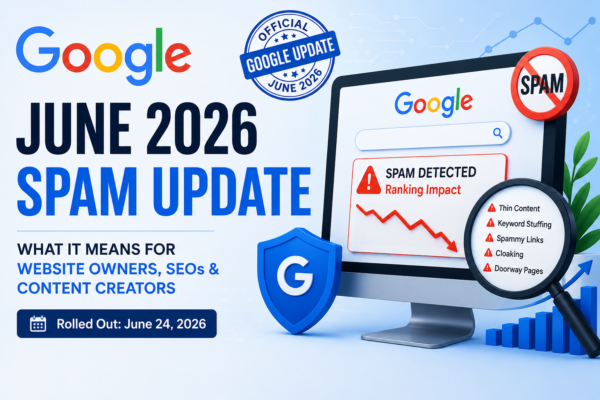
Google has officially begun rolling out its June 2026 Spam Update, marking the second spam-focused algorithm update of 2026. The rollout started on June 24, 2026, and is expected to take several days before reaching all search results worldwide. Unlike a Core Update, this release specifically targets websites that violate Google’s spam policies rather than changing how content quality is evaluated.
If you’ve noticed unexpected ranking fluctuations or traffic changes in the past few days, this update could be the reason.
What Is Google’s June 2026 Spam Update?
The June 2026 Spam Update is a global algorithm update designed to identify and reduce the visibility of websites that attempt to manipulate Google’s search results through spam techniques.
According to Google:
- The update affects all countries and all languages
- The rollout began on June 24, 2026
- Deployment may take a few days to complete
- No new spam policies were introduced with this release
This means Google is improving how it detects spam—not changing the rules.
Why Did Google Release This Update?
Google’s goal remains simple:
Provide users with trustworthy, relevant, and helpful search results while removing low-quality and manipulative content from SERPs.
Rather than rewarding websites that rely on shortcuts, Google continues investing in AI-powered systems that detect spam at scale.
One of the biggest technologies behind this effort is SpamBrain, Google’s AI-based spam detection system that continuously evolves to identify new spam tactics.
Which Websites Could Be Affected?
Although Google hasn’t released a detailed list, websites using spammy SEO tactics are most likely to experience ranking drops.
Common risk factors include:
1. AI-Generated Content Published Without Human Review
Publishing hundreds of AI-written pages with little value, originality, or expertise.
2. Keyword Stuffing
Repeating keywords unnaturally to manipulate rankings.
3. Cloaking
Showing different content to search engines than human visitors.
4. Hidden Text & Links
Using invisible content solely for SEO purposes.
5. Doorway Pages
Creating multiple low-quality pages targeting slight keyword variations that all lead to the same destination.
6. Expired Domain Abuse
Buying expired domains only to pass authority without offering relevant value.
7. Automatically Generated Thin Pages
Large-scale pages with little useful information created purely to capture search traffic.
What This Update Does NOT Target
Many website owners panic whenever Google announces an update.
However, the June 2026 Spam Update is not aimed at every website that loses rankings.
Current reports indicate this rollout is not specifically targeting:
- Genuine helpful content
- Websites following Google’s Search Essentials
- Businesses with authentic SEO strategies
- Legitimate backlink profiles
- Standard content optimization practices
If your site follows white-hat SEO, there’s usually no reason to worry.
How to Check If Your Website Was Impacted
Watch these metrics over the coming days:
- Organic traffic in Google Analytics 4
- Search impressions in Google Search Console
- Keyword ranking movements
- Indexed pages
- Click-through rate (CTR)
- Manual Action reports
Avoid making major SEO changes until the rollout has fully completed, as rankings may fluctuate during deployment.
What Should You Do Right Now?
Instead of reacting immediately, use this opportunity to improve your website.
Audit Your Content
Ask yourself:
- Does this page genuinely solve a user’s problem?
- Is it unique?
- Would someone bookmark or share it?
If the answer is “no,” improve or consolidate the content.
Remove Thin Pages
Delete or merge pages that:
- Have little useful information
- Receive no traffic
- Exist only to target keywords
Quality matters far more than quantity.
Focus on E-E-A-T
Google increasingly rewards websites that demonstrate:
- Experience
- Expertise
- Authoritativeness
- Trustworthiness
Show author information, cite credible sources, include original insights, and keep your content accurate and up to date.
Avoid Shortcut SEO
Practices that may trigger spam signals include:
- Buying low-quality backlinks
- Mass-producing AI content without editing
- Private Blog Networks (PBNs)
- Hidden redirects
- Cloaking
- Automated link schemes
Short-term gains often lead to long-term ranking losses.
Will AI Content Be Penalized?
No not simply because it’s AI-generated.
Google has repeatedly stated that it evaluates content quality, not how the content was created. AI can be a useful drafting tool, but content should be reviewed, edited, fact-checked, and enhanced with original expertise before publication.
Key Takeaways
The June 2026 Spam Update reinforces Google’s long-term direction:
- Help users, not search engines.
- Prioritize expertise and originality.
- Eliminate manipulative SEO practices.
- Reward websites that provide genuine value.
If your SEO strategy is built around helpful content, technical optimization, and a great user experience, updates like this are more likely to benefit your site than harm it.
Final Thoughts
Google’s spam updates are no longer just about catching obvious spam. They increasingly rely on AI to identify subtle manipulation while rewarding websites that consistently deliver trustworthy, people-first content.
Rather than chasing algorithm loopholes, invest in creating content that demonstrates real expertise, answers user questions thoroughly, and builds long-term credibility. That’s the strategy that continues to work—regardless of how Google’s algorithms evolve.
Need help auditing your website after the June 2026 Spam Update?
Our SEO experts can perform a complete technical and content audit to identify issues, recover lost rankings, and build a future-proof SEO strategy.