Artificial intelligence is changing how people create videos. From AI voiceovers and face swaps to fully generated clips, creators now have powerful tools at their fingertips. As AI content grows, YouTube is tightening its rules to help viewers understand what they are watching.
The latest focus is the YouTube altered content policy, which requires creators to disclose realistic AI-generated or significantly modified content. The platform has also improved AI disclosure options for creators uploading videos from Android devices, making compliance easier.
For YouTubers, digital marketers, journalists, educators, and businesses, understanding these updates is essential. Failing to follow the rules could affect video visibility, monetization, or even lead to content removal in some situations.
This article explains the latest YouTube AI policy 2026, the YouTube AI label system, and what altered content YouTube meaning is in practical terms.
Why YouTube Updated Its AI Content Policy
AI-generated media has become more realistic than ever. Today, creators can generate:
- AI avatars
- Deepfake videos
- AI voice cloning
- Synthetic news footage
- AI-generated interviews
- Fully AI-created landscapes and animations
While these technologies improve creativity, they also increase misinformation risks.
Imagine a realistic AI video showing a politician making a fake announcement or a celebrity promoting a product they never endorsed. Without proper disclosure, many viewers could believe the content is real.
YouTube introduced stronger transparency measures to maintain trust between creators and viewers.
What Is the YouTube Altered Content Policy?
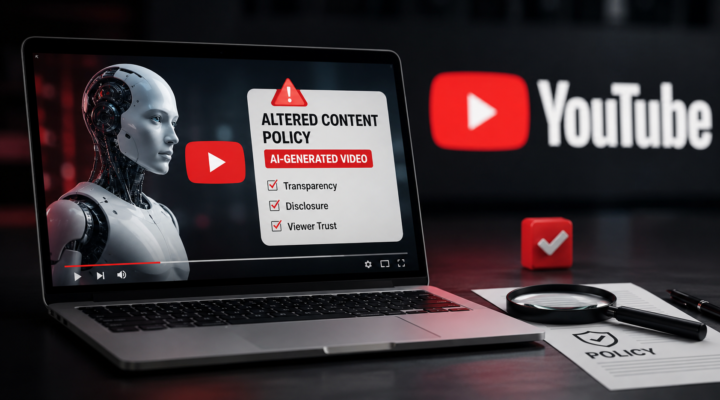
The YouTube altered content policy requires creators to disclose when realistic content has been significantly changed or created using AI.
The purpose is transparency, not banning AI.
Creators are expected to inform viewers whenever AI changes could confuse someone into believing synthetic content is real.
Examples include:
- Face swaps
- AI-generated people
- Voice cloning
- Digitally altered speeches
- AI-generated news scenes
- Synthetic disaster footage
- AI-created political content
Simple editing does not require disclosure.
Altered Content YouTube Meaning
Many creators ask about altered content YouTube meaning.
Altered content refers to videos where AI or editing significantly changes reality.
Examples requiring disclosure include:
| Content Type | AI Label Needed |
| AI voice cloning of a real person | Yes |
| Deepfake celebrity video | Yes |
| AI-generated news anchor | Yes |
| AI politician speech | Yes |
| AI-generated realistic explosion | Yes |
| Color correction | No |
| Background music | No |
| Basic transitions | No |
| Cropping or subtitles | No |
| Speed adjustments | No |
The rule focuses on realistic synthetic media, not ordinary editing.
What Is the YouTube AI Label?
The YouTube AI label is a disclosure shown to viewers when creators indicate their video contains realistic altered or synthetic content.
The label helps viewers understand that AI played a role in producing the video.
Examples include:
- “Altered or synthetic content”
- AI-generated scenes
- Digitally recreated individuals
This label improves transparency without discouraging AI creativity.
How Android Uploads Now Support AI Disclosure
Many creators upload videos directly from Android smartphones.
YouTube has expanded disclosure tools within the Android upload process.
Creators uploading from Android can now more easily indicate whether their content contains significant AI-generated material.
This helps mobile creators remain compliant without switching to desktop publishing.
For travel vloggers, journalists, influencers, educators, and small businesses, mobile publishing has become the primary workflow. Integrating AI disclosure directly into Android uploads simplifies compliance.
When Can YouTube Remove AI Videos?
Many headlines suggest YouTube has a “device AI generated video remove policy.”
This is only partly true.
YouTube does not remove videos simply because AI created them.
Removal usually happens when AI content violates existing policies.
Possible reasons include:
- Misleading viewers
- Election misinformation
- Harmful deepfakes
- Privacy violations
- Copyright infringement
- Scam content
- Impersonation
- Harassment
The issue is not AI itself.
The issue is harmful or deceptive AI.
YouTube AI Policy 2026: What Has Changed?
The YouTube AI policy 2026 builds on earlier transparency efforts.
Key improvements include:
Better Disclosure Tools
Creators have clearer upload options for AI-generated content.
Greater Viewer Transparency
Labels appear where viewers need context.
Protection Against Deepfakes
YouTube has expanded reporting systems for synthetic media involving public figures.
Stronger Privacy Protection
People whose likeness is recreated using AI have more options to request review.
Focus on Trust
YouTube wants responsible AI innovation rather than restricting creators.
Why This Matters for Content Creators
AI saves enormous amounts of production time.
Creators now use AI for:
- Script writing
- Video translation
- Subtitle generation
- Voiceovers
- Animation
- Thumbnail creation
- Image generation
- Video enhancement
Transparency allows creators to continue using these tools while maintaining audience trust.
A simple disclosure is much better than risking policy violations later.
Industry Trends Driving AI Disclosure
The creator economy continues to grow rapidly.
Several global studies estimate that:
- More than 2.7 billion people watch YouTube every month.
- Hundreds of hours of video are uploaded every minute.
- AI-powered editing software adoption among creators continues to rise each year.
- Generative AI investment exceeded tens of billions of dollars globally in recent years.
As AI becomes mainstream, transparency standards are becoming equally important.
Major platforms including Google, Meta, TikTok, and LinkedIn are investing in AI content identification technologies.
India’s Growing Role in AI Video Creation
India has become one of the fastest-growing digital creator markets.
Several factors support this growth:
- Affordable smartphones
- Low-cost internet access
- Growing creator economy
- Rapid AI adoption
- Expanding digital education
- Increasing exports of digital services
Indian creators increasingly use AI for:
- Regional language dubbing
- Educational content
- Product explainers
- Travel videos
- Business marketing
- Export promotion
For export businesses, AI enables affordable multilingual product demonstrations for buyers across Europe, the Middle East, Africa, and North America.
As India expands its digital economy, responsible AI usage will strengthen global credibility for Indian creators and exporters.
Real-World Examples
Educational Channels
Teachers generate AI animations explaining science concepts while disclosing AI-generated visuals.
Travel Creators
Creators recreate historical landmarks using AI while informing viewers about synthetic scenes.
Business Channels
Export companies use AI avatars to explain manufacturing processes in multiple languages.
News Analysis
Journalists use AI-generated graphics to visualize economic data without misleading audiences.
These examples show AI enhances storytelling when transparency comes first.
Best Practices for Using AI on YouTube
Follow these practices to stay compliant.
- Always disclose realistic AI-generated content.
- Avoid creating misleading deepfakes.
- Respect copyright ownership.
- Never impersonate real individuals without permission.
- Verify facts before publishing AI-assisted news.
- Keep original footage whenever possible.
- Use AI as a creative assistant, not a replacement for accuracy.
Common Misconceptions
Myth: YouTube bans all AI videos.
False.
Millions of AI-assisted videos remain fully monetized.
Myth: Every AI thumbnail needs disclosure.
False.
Disclosure mainly applies to realistic altered video content.
Myth: AI voiceovers are always prohibited.
False.
Disclosure depends on how realistic and potentially misleading the content is.
Myth: Android uploads receive different rules.
False.
The policy applies equally across devices. Android now simply offers improved disclosure support.
Key Takeaways
Important points every creator should remember:
- The YouTube altered content policy promotes transparency, not censorship.
- The YouTube AI label informs viewers when realistic AI-generated content is used.
- The YouTube AI policy 2026 focuses on trust and responsible AI.
- Videos are removed for policy violations, not because they use AI.
- Indian creators have significant opportunities to lead global AI-powered content creation through ethical practices.
FAQs
1. What is the YouTube altered content policy?
It requires creators to disclose realistic AI-generated or significantly modified content that viewers might mistake for real.
2. What does the YouTube AI label mean?
The label tells viewers a video includes altered or synthetic content created using AI or advanced editing.
3. Will YouTube remove AI-generated videos?
No. AI videos are allowed. Videos are removed only if they violate YouTube’s Community Guidelines, copyright rules, or misinformation policies.
4. Does the policy apply to Android uploads?
Yes. Android users are expected to follow the same disclosure rules, and YouTube has made AI disclosure easier within the mobile upload process.
5. Do I need to label every AI-edited video?
No. Routine edits like trimming, filters, subtitles, and color correction generally do not require AI disclosure. The label is mainly intended for realistic synthetic or significantly altered content.
Conclusion
Artificial intelligence is reshaping video creation at an unprecedented pace. The YouTube altered content policy represents a shift toward transparency rather than restriction. By introducing clearer AI disclosures and improving mobile upload workflows, YouTube aims to balance innovation with viewer trust.
For creators, businesses, and exporters, the message is clear. Continue using AI to improve productivity, but be open about when realistic content has been generated or significantly altered. Ethical AI practices will become a competitive advantage as audiences demand authenticity and regulators introduce new standards.
Looking ahead, AI-generated video will become even more sophisticated. Creators who combine creativity, accurate information, and transparent disclosure will be better positioned to build loyal audiences, protect monetization, and grow sustainably in the evolving digital landscape.