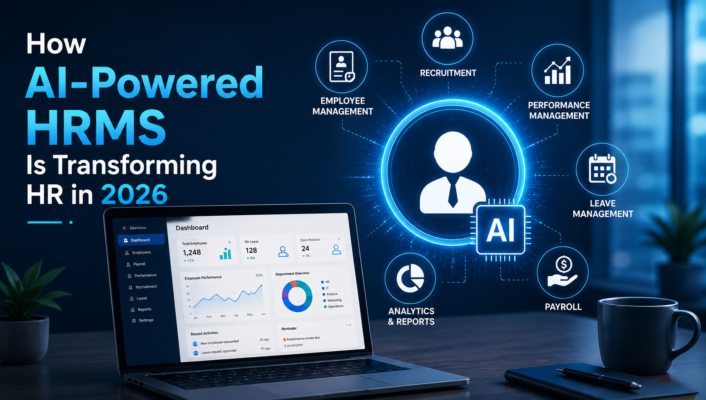
Human resource management is changing fast. For years, HR teams spent a large part of their day handling attendance records, leave requests, payroll inputs, employee documents, recruitment coordination, and routine queries.
In 2026, artificial intelligence is changing this model.
An AI-powered HRMS is helping businesses automate repetitive work, analyse workforce data, improve employee experiences, and support faster decision-making. The role of HR is shifting from administration toward workforce strategy.
This shift is especially important for Indian businesses.
India is among the world’s fastest-growing AI markets. According to recent government-backed data, 87% of Indian enterprises were actively using AI solutions by late 2025. Indian organisations are also moving AI from experimentation into daily business operations.
For company owners, managing directors, HR heads, and admin teams, the question is no longer whether AI will enter HR.
The real question is how to use it responsibly and effectively.
What Is an AI-Powered HRMS?
An AI-powered HRMS is a Human Resource Management System that combines traditional HR software with artificial intelligence.
A standard HRMS software typically manages:
- Employee records
- Attendance and leave
- Payroll information
- Recruitment workflows
- Performance records
- Employee documents
- Compliance processes
An AI HRMS software adds intelligence to these processes.
Instead of only storing data, the system can identify patterns, generate insights, answer employee questions, and automate selected workflows.
For example, an employee management system might identify:
- Departments with unusually high absenteeism
- Skills gaps across teams
- Recruitment bottlenecks
- Employees at potential risk of leaving
- Repetitive HR queries that can be automated
- Workforce trends requiring management attention
The key difference is simple.
Traditional HR software records what happened.
AI-powered HRMS helps HR teams understand what is happening and what may require attention next.
Why AI in HR Is Growing Rapidly in 2026
AI adoption has moved beyond technology companies.
Deloitte’s 2026 India research found that 40% of Indian respondents reported significant or full AI usage, compared with about 28% globally. More than half of Indian organisations have also started integrating AI into HR and work processes.
Employee adoption is also increasing.
ADP Research reported in 2026 that 80% of employees in India use AI multiple times a week, while 41% use it daily.
This creates a new expectation inside businesses.
Employees already interact with intelligent digital tools in their daily work. They increasingly expect the same speed and convenience from internal HR services.
Key factors driving AI HRMS adoption
Businesses are adopting HR automation software for several reasons:
- Growing workforce complexity
- Higher employee expectations
- Pressure to reduce administrative work
- Demand for faster hiring
- Increased focus on workforce analytics
- Need for better compliance monitoring
- Greater demand for personalised employee experiences
For growing companies, managing people through spreadsheets and disconnected software is becoming difficult.
AI-powered HRMS offers a more connected approach.
How AI-Powered HRMS Is Transforming HR Management
1. Automating Routine HR Tasks
The first major benefit is automation.
HR teams often spend hours handling repetitive requests.
AI can support tasks such as:
- Leave and attendance queries
- Employee policy questions
- Document retrieval
- Onboarding checklists
- Interview scheduling
- Basic payroll-related queries
- Employee service requests
For example, instead of emailing HR to ask about leave balance, an employee can interact with an AI-powered assistant.
This reduces routine workload.
It also gives HR professionals more time for activities such as:
- Talent development
- Employee engagement
- Workforce planning
- Leadership support
- Retention strategies
PwC’s Future of Work Survey found that 65% of respondents said automation or GenAI had already changed HR team structures or roles.
2. Making Recruitment Faster and More Structured
Recruitment is one of the most important areas for AI in HR.
Hiring teams often deal with hundreds or thousands of applications.
AI HRMS software can help organise this process.
It can support:
- Resume parsing
- Candidate skill matching
- Interview scheduling
- Job description analysis
- Recruitment pipeline tracking
- Candidate communication
Consider a growing technology company hiring 50 employees.
Without automation, HR teams might manually review applications, update spreadsheets, schedule interviews, and follow up with candidates.
An AI-powered HR management software platform can centralise much of this workflow.
However, businesses should avoid giving AI complete control over hiring decisions.
Human review remains essential.
AI can help identify relevant information, but managers must consider experience, context, communication skills, and organisational fit.
3. Turning HR Data Into Actionable Insights
Many companies collect large amounts of employee data.
The problem is often not a lack of data.
The problem is a lack of useful insights.
AI-powered HRMS platforms are increasingly helping businesses analyse information from:
- Attendance
- Performance
- Recruitment
- Learning
- Employee engagement
- Workforce movement
For example, the system might identify that a specific department has:
- Rising absenteeism
- Higher employee turnover
- Falling engagement scores
- Longer hiring cycles
This gives HR leaders an opportunity to investigate before the issue becomes larger.
Deloitte reported in July 2026 that 43% of organisations had reached advanced people analytics maturity, although more than 70% still relied on static reporting approaches.
This gap creates a major opportunity.
Businesses that move from static reports toward real-time workforce insights can make faster people decisions.
Traditional HRMS vs AI-Powered HRMS
| Feature | Traditional HRMS Software | AI-Powered HRMS |
| Employee data | Stores information | Analyses patterns and insights |
| HR queries | Manual support | AI-assisted responses |
| Recruitment | Tracks candidates | Supports screening and matching |
| Reporting | Static reports | Predictive and real-time insights |
| Employee experience | Standard workflows | More personalised interactions |
| Automation | Rule-based | Intelligent workflow support |
| Decision-making | Historical data | Data-supported forecasting |
The goal is not to remove human involvement.
The goal is to reduce repetitive work and improve decision quality.
4. Improving Employee Experience
Employees increasingly expect workplace systems to work like modern consumer apps.
They want quick answers.
They want easy access to information.
They do not want to send multiple emails for simple HR requests.
An AI-powered employee management system can provide:
- 24/7 HR assistance
- Faster answers to common questions
- Personalised learning suggestions
- Automated onboarding guidance
- Self-service access to documents
- Intelligent reminders
This is particularly useful for companies with remote or distributed teams.
A well-designed HRMS software platform gives employees more control over routine activities while reducing pressure on HR teams.
5. Supporting Better Workforce Planning
Company owners and managing directors need answers to strategic questions.
For example:
- Which skills will the company need next year?
- Which departments are growing fastest?
- Where are recruitment costs increasing?
- Which roles are difficult to fill?
- What skills gaps exist?
AI can help process large datasets and highlight workforce trends.
This supports a shift from reactive HR management toward proactive workforce planning.
According to Deloitte and nasscom, India’s demand for AI talent is expected to grow significantly, with the broader AI talent requirement projected to exceed 1.25 million by 2027.
This means businesses need stronger systems for:
- Skills tracking
- Employee development
- Internal mobility
- Workforce forecasting
An AI HRMS software platform can become an important source of workforce intelligence.
6. Personalising Learning and Employee Development
One of the biggest HR challenges is providing relevant training.
Traditional learning systems often assign the same courses to large groups.
AI allows a more targeted approach.
The system can recommend learning based on:
- Current role
- Skills
- Career goals
- Performance trends
- Future business requirements
This matters in India because workforce AI readiness is increasing rapidly.
Deloitte’s 2026 survey found that 85% of Gen Z and 91% of millennials in India were confident about applying AI in their roles.
Businesses that connect learning systems with HR data will be better positioned to develop future skills internally.
The Rise of AI Agents in HR
One important trend for 2026 is the growth of AI agents.
These are more advanced than basic chatbots.
A traditional chatbot answers questions.
An AI agent can potentially complete a sequence of approved tasks.
For example, an HR AI agent might:
- Receive an employee request
- Check the employee’s details
- Review relevant policies
- Route the request for approval
- Update the HR system
- Notify the employee
This level of automation can reduce manual coordination.
However, businesses should establish clear limits.
Sensitive actions involving:
- Hiring
- Termination
- Compensation
- Performance decisions
- Employee disciplinary matters
should retain appropriate human oversight.
Deloitte reported strong interest among Indian organisations in agentic AI, with more than 80% exploring autonomous agents in its 2025 India research.
India’s Growth Vision and the Role of AI HRMS
India’s AI growth story is closely connected to its workforce.
The country has a large working population, expanding digital infrastructure, and a growing technology ecosystem.
Government data published in 2026 noted that India ranked third in Stanford University’s 2025 Global AI Vibrancy Ranking. The same source highlighted India’s strong AI skills penetration and growing enterprise adoption.
For Indian businesses, AI-powered HRMS can support growth in several ways.
For startups
- Automate HR operations with smaller teams
- Build structured employee processes early
- Track workforce growth
For SMEs
- Reduce dependency on spreadsheets
- Improve attendance and employee records
- Standardise HR workflows
For large enterprises
- Analyse workforce data at scale
- Support strategic workforce planning
- Manage complex multi-location teams
India’s next stage of business growth will depend heavily on productivity and skills.
AI HRMS software can help organisations build stronger systems around both.
Risks Businesses Must Not Ignore
AI in HR brings important responsibilities.
Employee data is sensitive.
Businesses should not treat AI as a plug-and-play solution.
Key risks include:
Data privacy
HRMS platforms store information about employees.
Companies need clear policies around data collection, access, retention, and security.
Algorithmic bias
AI models can reflect bias present in historical data.
This is especially important in recruitment and performance evaluation.
Lack of transparency
Employees should understand when AI is being used in important HR processes.
Over-automation
Not every HR process should be automated.
Human conversations remain essential for complex and sensitive issues.
A strong approach combines technology with accountability.
How to Choose the Right AI HRMS Software
Before selecting HR software for businesses, focus on your actual operational needs.
Ask these questions.
1. Which HR processes consume the most time?
Start with your biggest problems.
It might be attendance, recruitment, onboarding, or employee queries.
2. Does the system integrate with your existing tools?
Your HR management software should connect smoothly with relevant systems.
3. How does the AI feature work?
Do not choose software only because it claims to be AI-powered.
Ask:
- What tasks does the AI perform?
- What data does it use?
- How are outputs reviewed?
- Can administrators control AI actions?
4. Does the platform protect employee data?
Review security controls and access permissions.
5. Can the system grow with your business?
Choose a platform that supports your future workforce size and complexity.
A Practical AI HRMS Implementation Plan
Businesses do not need to transform everything at once.
Follow a phased approach.
Phase 1: Audit current HR processes
Identify repetitive tasks and major bottlenecks.
Phase 2: Clean your HR data
AI works better when employee data is accurate and structured.
Phase 3: Start with high-value automation
Focus on areas such as:
- Employee self-service
- Onboarding
- Recruitment workflows
- Attendance insights
Phase 4: Train HR teams
Technology adoption requires people adoption.
Help HR professionals understand how to use AI responsibly.
Phase 5: Measure results
Track metrics such as:
- HR response time
- Recruitment cycle time
- Employee satisfaction
- Administrative workload
- Employee retention
Phase 6: Maintain human oversight
Review important AI-supported decisions.
Keep accountability with people.
Key Takeaways
- AI-powered HRMS is moving HR from administration toward strategic decision-making.
- AI can automate repetitive tasks and improve employee self-service.
- Workforce analytics is becoming a major competitive advantage.
- AI HRMS software can support smarter recruitment and skills development.
- Indian businesses are adopting AI at a fast pace.
- Employee data privacy and AI governance must remain priorities.
- Human judgment remains essential in sensitive HR decisions.
Conclusion: The Future of AI-Powered HRMS
In 2026, an AI-powered HRMS is becoming more than a digital record-keeping system.
It is evolving into a workforce intelligence platform.
The strongest businesses will not use AI simply to reduce headcount or automate every interaction. They will use AI to remove repetitive work, identify workforce trends, improve employee experiences, and help managers make better decisions.
For HR heads, company owners, and managing directors, the next step should be practical.
Start with one business problem.
Improve the data.
Introduce automation carefully.
Measure the outcome.
Then expand.
India’s AI-driven growth will depend on how effectively businesses combine technology with human skills. HR teams sit at the centre of this transformation.
The future of HR is unlikely to be fully automated.
It will be human-led and AI-supported.
FAQs
1. What is an AI-powered HRMS?
An AI-powered HRMS is HR management software that uses artificial intelligence to automate tasks, analyse workforce data, provide insights, and improve employee services.
2. How is AI used in HR management?
AI in HR supports recruitment, employee queries, onboarding, workforce analytics, learning recommendations, and HR automation. Human oversight remains important for major people decisions.
3. What are the benefits of AI HRMS software?
Key benefits include reduced administrative work, faster HR processes, better workforce insights, improved employee self-service, and more informed decision-making.
4. Is AI-powered HRMS suitable for small businesses?
Yes. Small and growing businesses can use HR automation software to manage employee records, attendance, onboarding, and routine HR workflows more efficiently. The best choice depends on workforce size and business needs.
5. Will AI replace HR professionals?
AI is more likely to change HR roles than replace them completely. Routine administrative tasks are increasingly automated, while HR professionals focus more on strategy, employee experience, leadership, culture, and complex people decisions.